

Tax Strategies Every Business Owner Should Know Before Retirement
From cash balance plans to Roth conversions, here are the tax strategies business owners should be using in the years before retirement to keep more wealth.
%20(7).png)
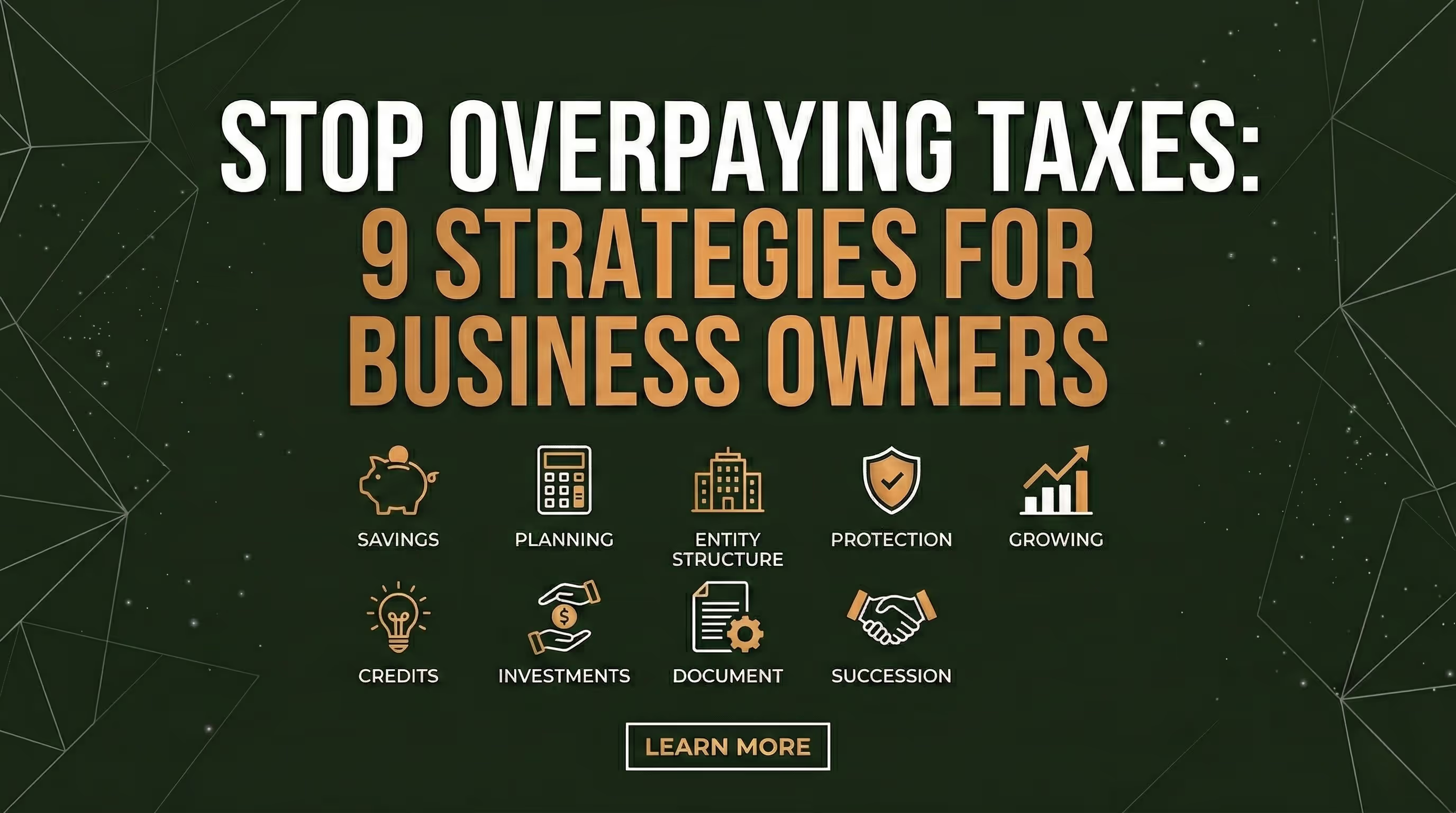

Most business owners pay more in taxes than they need to. That is not a criticism. It is a structural reality that emerges from operating a profitable business, generating significant personal income, and simply not having time to navigate a tax code that rewards proactive planning far more than reactive scrambling each April.
The business owners who keep the most of what they earn are not the ones who found the cleverest loopholes or worked with the most aggressive CPA. They are the ones who engaged in deliberate, coordinated tax planning year after year, consistently using legitimate strategies that are available to any business owner who takes the time to implement them.
This article covers the strategies most worth considering in the years leading up to retirement. Some of these you may already be using. Others may open the door to a conversation with your CPA or financial advisor that saves you more money than you expected.
1. Maximize Tax-Deferred Retirement Contributions Every Year
This one sounds obvious, but you would be surprised how many business owners are not fully using the retirement account contribution limits available to them each year.
A SEP IRA allows you to contribute up to 25 percent of net self-employment income, with a 2026 limit of $72,000. A Solo 401(k) allows even more flexibility, with employee contribution limits of up to $24,500 in 2026 plus employer profit-sharing contributions that bring the combined limit to $72,000 for those under 50, plus additional catch up contribution amounts for those 50 and older. A SIMPLE IRA allows employee contributions up to $17,000 in 2026, though the limits are lower than the other options.
The specific plan type that makes the most sense depends on your business structure, whether you have employees, and your income level. The right answer varies, and it is worth reviewing your current plan setup annually to ensure you are using the most advantageous vehicle for your situation.
2. Explore a Cash Balance Plan or Defined Benefit Plan for Dramatically Higher Contributions
For business owners in their late 40s, 50s, and early 60s who are profitable and want to accelerate retirement savings significantly, a cash balance plan is one of the most powerful tax tools available.
A cash balance plan is a type of defined benefit pension plan that allows contributions to be determined actuarially based on the participant's age, salary, and the targeted benefit at retirement. Because older participants have fewer years for contributions to compound before retirement age, the allowable annual contribution for someone in their late 50s or early 60s can reach $200,000 to $300,000 or more per year.
These contributions are fully deductible to the business, which means a business owner contributing $250,000 to a cash balance plan in a year when they are in the top federal bracket could save tens of thousands in federal taxes on those contributions alone. The assets in the plan grow tax-deferred and can eventually be rolled over into a traditional IRA upon retirement or termination of the plan.
Cash balance plans work best for profitable businesses that can sustain the required annual contributions, as the funding obligations are relatively fixed once the plan is established. They are not a tool for businesses with highly variable income. But for a stable, profitable private practice or closely held business, a cash balance plan implemented in the five to ten years before retirement can generate hundreds of thousands of dollars in tax savings over the life of the plan.
3. Optimize Your Business Entity Structure
The entity structure through which your business operates has significant tax implications, and many business owners are not operating in the most tax-efficient structure for their current situation.
For many self-employed individuals and small business owners, operating as an S-corporation rather than a sole proprietor or single-member LLC can reduce self-employment tax meaningfully. The mechanics work like this: as an S-corporation owner, you pay yourself a reasonable salary, which is subject to payroll taxes. But profits above that salary that are distributed to you as an owner are not subject to self-employment tax. For a business generating $400,000 in net income, the self-employment tax savings from an S-corporation structure can reach $15,000 to $25,000 per year or more.
That said, an S-corporation is not right for every business or every owner. There are administrative costs, payroll requirements, and restrictions on ownership that need to be evaluated. The question of whether your current entity structure is optimal is worth reviewing with your CPA every few years, particularly as your income grows and as you approach an eventual business sale or exit.
4. Implement a Systematic Year-End Tax Review
Year-end tax planning is not something that should happen in December when there is limited time to act. It should be a mid-year and third-quarter process that identifies opportunities while you still have time to implement them meaningfully.
Key areas to review annually with your CPA include your income level and tax bracket for the current year relative to your expected bracket next year, whether accelerating or deferring income or deductions would reduce your overall tax burden, your estimated quarterly tax payments and whether they are on track to avoid underpayment penalties, opportunities for bonus depreciation or Section 179 deductions on equipment purchases, and whether any capital loss harvesting opportunities exist in your investment portfolio.
One of the most valuable things a business owner can do is schedule a mid-year check-in with both their CPA and their financial advisor, not just a year-end scramble. The conversations that happen in summer or early fall, when there is still runway to act, are often far more productive than the ones that happen in late November.
5. Use Depreciation Strategically
The tax code offers business owners the ability to write off the cost of eligible business assets much faster than the assets actually wear out, and this accelerated depreciation can generate significant tax deductions in years when they are most valuable.
Section 179 of the tax code allows businesses to immediately deduct the full cost of qualifying equipment and software in the year of purchase rather than depreciating it over multiple years. For 2026, the Section 179 deduction limit is $2,560,000. Bonus depreciation, which has been phasing down in recent years, also allows for immediate expensing of a percentage of eligible asset costs.
For business owners who have real estate holdings in addition to their operating business, a cost segregation study may be worth serious consideration. A cost segregation study is an engineering-based analysis that identifies components of a commercial building that can be depreciated over shorter time periods than the standard 39 years for commercial real estate. By accelerating depreciation on those components, you can generate large paper losses that offset ordinary income in the years the study is conducted. For a commercial building valued at $2 million, a cost segregation study has the potential to generate tens of thousands of dollars in depreciation deductions in the first few years of ownership.
6. Plan Strategically Around Roth Conversions
Roth conversion strategy is an area where business owners have unique and sometimes underutilized opportunities.
The basic concept is straightforward: you convert pre-tax retirement account balances, like a traditional IRA or 401(k), into a Roth IRA by paying income tax on the converted amount today, in exchange for tax-free growth and tax-free withdrawals in the future with no required minimum distributions.
The optimal time to do Roth conversions is in years when your taxable income is relatively low. For a business owner, those years sometimes include the period immediately after a business sale or transition when salary income has stopped, a year when the business had an unusually low profit, or early retirement years before Social Security and required minimum distributions begin.
Deliberately engineering those low-income years and using them to convert significant pre-tax retirement balances to Roth can produce substantial long-term tax savings, particularly for business owners who accumulated large tax-deferred balances over their career and expect their estate to be subject to estate taxes.
7. Leverage Charitable Giving Strategies to Reduce Current-Year Tax
For business owners who are charitably inclined, there are tax-efficient giving strategies that go well beyond writing a check at the end of the year.
A donor-advised fund allows you to make a large, immediately deductible contribution in a high-income year, then distribute grants to your chosen charities over time. Contributing in a high-income year maximizes the value of the deduction, while the timing of distributions to your chosen charities remains entirely within your control.
Contributing appreciated securities, whether publicly traded stocks or appreciated business interests in some cases, directly to a charity or donor-advised fund allows you to avoid paying capital gains tax on the appreciation while still receiving a charitable deduction for the full fair market value. This is generally more efficient than selling the appreciated asset, paying the capital gains tax, and then donating the after-tax cash.
For business owners with significant real estate or business interests, a Charitable Remainder Trust can allow you to contribute an appreciated asset, receive an immediate partial charitable deduction, avoid capital gains tax on the contribution, and receive an income stream from the trust for your lifetime or a defined period. The remaining trust assets eventually pass to your designated charity. It is a complex strategy with meaningful administrative requirements, but for the right situation it can accomplish multiple planning goals simultaneously.
8. Get Ahead of the Estate and Gift Tax Picture
For business owners with significant wealth, estate and gift tax planning deserves attention well before retirement. The federal estate and gift tax exemption is currently elevated under the Tax Cuts and Jobs Act, but provisions of that legislation are scheduled to sunset at the end of 2025, which would reduce the exemption roughly in half unless Congress acts.
Annual gifting, currently $19,000 per recipient per year in 2026 without using lifetime exemption, allows business owners to systematically transfer wealth out of their taxable estate over time. For a business owner with several children and grandchildren, annual gifting across the family can transfer several hundred thousand dollars per year without any gift tax implications.
More sophisticated strategies, including irrevocable trusts designed to pass assets out of the taxable estate while retaining some economic benefit, and intentional defective grantor trusts designed to allow installment sales of business interests to family members in a tax-efficient manner, deserve discussion with an estate planning attorney and financial advisor for any business owner with a taxable estate.
9. Avoid Overpaying on Investment Expenses Inside Your Retirement Plan
Business owners who have established retirement plans for their businesses have a fiduciary responsibility to plan participants, including themselves, to ensure the plan's investment options are reasonably priced. But beyond the legal obligation, there is a straightforward financial one as well.
Mutual funds and investment options inside retirement plans vary enormously in their expense ratios. A plan loaded with high-cost actively managed funds charging 1 to 1.5 percent per year in expenses has the potential to eat into net returns for participants over time than a plan built around low-cost index funds charging 0.05 to 0.20 percent. For a retirement plan with $1 million in assets, that difference in expenses compounds to hundreds of thousands of dollars over a 20-year period.
If your plan's investment menu has not been reviewed recently or if you are uncertain what you are paying in fees, that review is worth prioritizing.
Bringing It All Together
No single strategy on this list is going to transform your tax situation on its own. The business owners who pay the least in taxes over their careers are the ones who implement multiple strategies in a coordinated way, year after year, with their CPA and financial advisor working in concert rather than in parallel silos.
If you are a business owner in the years leading up to retirement and you feel like your tax planning is reactive rather than proactive, or if you are simply not sure whether your current approach is capturing all the opportunities available to you, that is exactly the kind of conversation we enjoy having at Oread Wealth Partners.
Tax planning is central to our work with business owner clients. We help coordinate the financial planning, investment management, and tax strategy into a coherent whole rather than a collection of disconnected recommendations.
Schedule your complimentary 30-minute consultation with Oread Wealth Partners here.
More Blogs & Insights
More insights on financial planning, investing, tax strategy, and retirement planning for physicians and business owners.


Book a Free Assessment
We take time to understand your goals, values, and motivations before building a financial plan designed around your life.
Our calls are always stress and pressure free—guaranteed!